Mito castle town
Remembered as second daughter Yae, aged seventeen, pending genealogy and roster evidence
The unsupported former name Yatsu has been corrected to Yae.
Know the Person
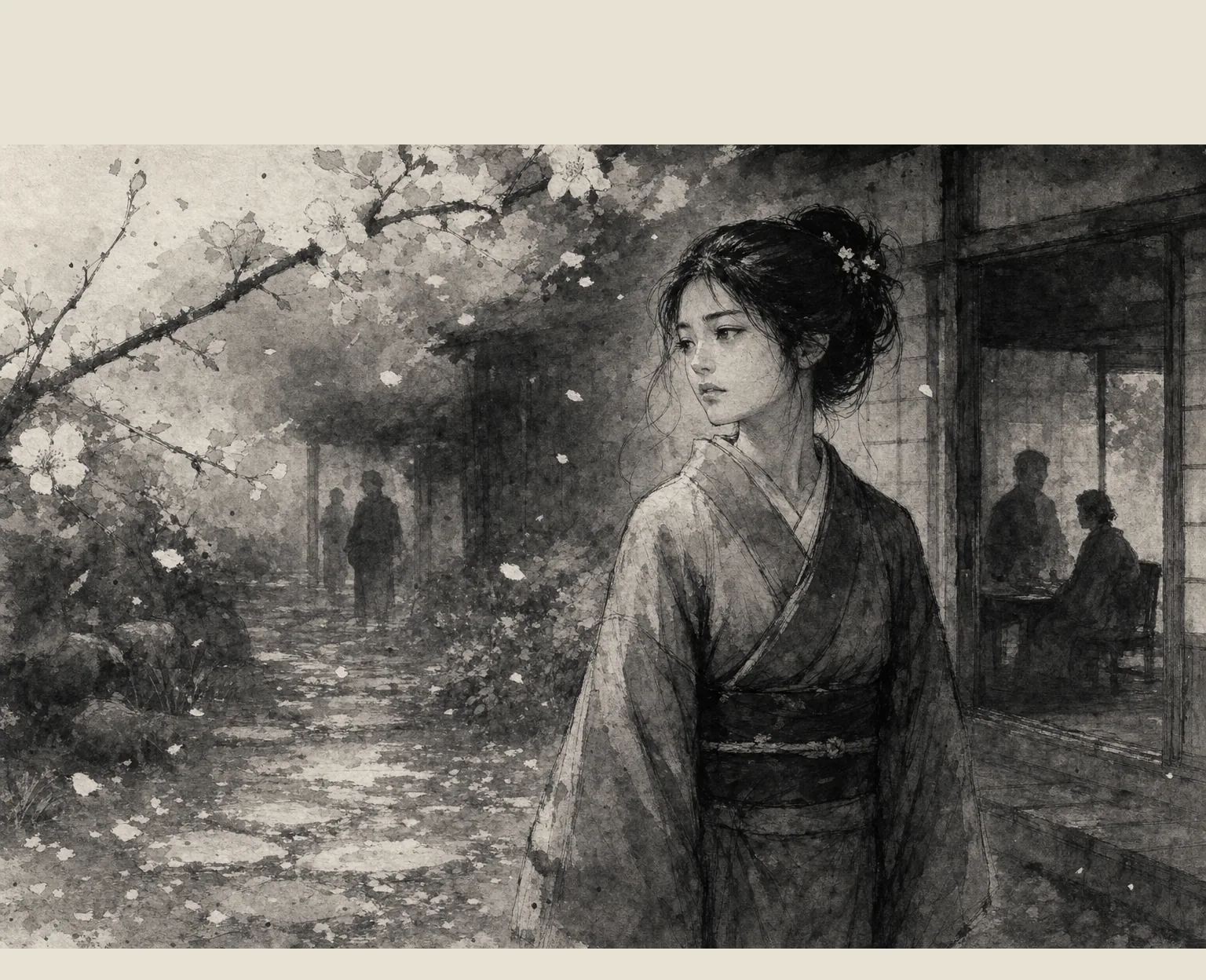
Circulated accounts identify the poet as Yae, the seventeen-year-old second daughter of Tengu Party leader Tamaru Inanoemon. The variant name Yatsu lacks firm support and must be treated as an unresolved transmission rather than an established personal name. Her birth, household roster, confinement, execution date and site, and the original witness for “Together we set out / on the journey to death / while flowers are in full bloom” still require verification. Those gaps cannot responsibly be filled with invented biography. It examines a Tamaru family archive through genealogy, accounts, sewing tools, and practice paper; her father’s magistrate office through town maps, complaint books, seals, and tags; collective punishment through confiscation inventories, keys, and sealed bundles; prison life through mats, water jars, ration bowls, medicine, parcels, and registers; execution traditions through orders, route maps, and multiple sites without staging death; and the poem through variant copies, catalogs, publication dates, and citation chains. Objects are contextual research subjects, not claimed possessions. Reading paths lead to Mito women, samurai households, magistrates, collective punishment, prisons, death poetry, and source criticism.
Life
Mito castle town
The unsupported former name Yatsu has been corrected to Yae.
Mito castle town
No office role or personal possessions are invented for Yae.
Tsukuba and Mito
Military chronology and family punishment remain separate sequences.
Mito prisons and custody sites
Yae’s prison and detention dates remain unverified.
Mito region
Date, companions, location, and burial are not supplied from narrative convenience.
Family papers, local histories, libraries
Original witness, variants, earliest printing, and circular citation remain research tasks.

茨城県水戸市緑町
『旧常陸水戸徳川家中川瀬家・田丸家文書目録』を入口に、八重の名・年齢・続柄を原資料で探索する。所蔵情報と閲覧条件は事前確認する。
田丸八重・田丸家
Address茨城県水戸市緑町2丁目1-15
Nearby
茨城県水戸市三の丸
町奉行の役所・田丸家屋敷の正確な位置は史料確認が必要。弘道館を本人の家や執務所とはせず、城下図と役職記録を照合する。
田丸稲之衛門・田丸家
Address茨城県水戸市三の丸1丁目6-29周辺
Nearby
茨城県つくば市筑波
1864年3月の挙兵と、その後の家族への連座は別の時間と場所である。八重本人が筑波山にいたとは示さない。
田丸稲之衛門・筑波勢
Address茨城県つくば市筑波
Nearby
茨城県水戸市東台2丁目
赤沼牢は現在の東台2丁目にあったとされる。ただし八重の収監場所と期間は原典で未確認のため、本人の牢として断定しない。
天狗党関係者の家族
Address茨城県水戸市東台2丁目周辺
Nearby
茨城県水戸市
天狗党事件後は複数地点で処刑が行われた。八重の処刑地・同行者・日付は原典未確認のため、一つの現在地へ固定しない。
天狗党関係者の家族
Address茨城県水戸市大町3丁目3-20(水戸市立博物館)
Nearby
茨城県水戸市三の丸
流布形をそのまま一次史料とせず、水戸藩史料、家文書目録、地域史、後世の読み物を刊行年順に並べる。
田丸八重
Address茨城県水戸市三の丸1丁目5-38
Nearby
Keys

Reliable personal information about Tamaru Yae is scarce. Circulated accounts call her the seventeen-year-old second daughter of Tengu Party leader Tamaru Inanoemon. The former name Yatsu could not be supported in searchable official or bibliographic sources and has been corrected. The catalog of the former Mito Tokugawa Kawase and Tamaru family papers, genealogy, birth and death records, household accounts, clothing chests, sewing boxes, thread reels, combs, practice sheets, and family seals offer routes toward her name, relationship, age, and domestic setting. None of the pictured objects is claimed as her possession. Women may appear only as “daughter” in one record and receive a personal name in a later genealogy, so author and date matter. Reading paths include Mito retainer families, women, household management, sewing, education, and archival catalogs.
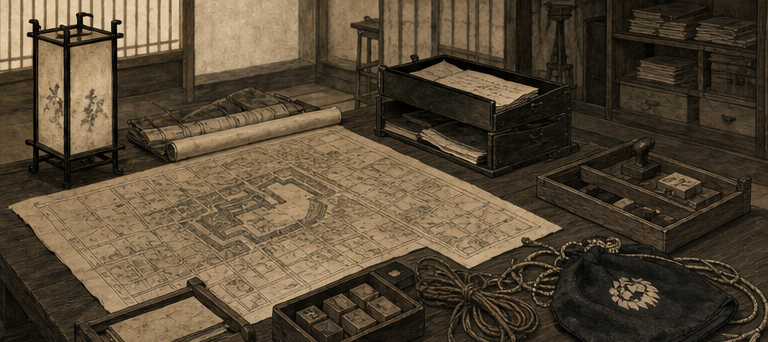
Yae’s father Tamaru Inanoemon was a Mito retainer and town magistrate who became a leader in the March 1864 Tsukuba uprising. Castle-town maps, town proclamations, complaint registers, prison books, seal boxes, document trays, wooden tags, messenger bags, measuring cords, and patrol lanterns show a magistrate’s responsibilities for order, litigation, town officials, prisons, roads, and markets. The later label of loyalist leader should not erase office history, residence, stipend, subordinates, and relations with townspeople. Kodo-kan was a domain school, not automatically the Tamaru residence or magistrate office. No role for Yae in office work is inferred. Instead, the page asks how a political office connected household residence, income, and legal status to decisions made by one member. Reading paths include Mito town plans, magistrates, domain law, policing, and courts.

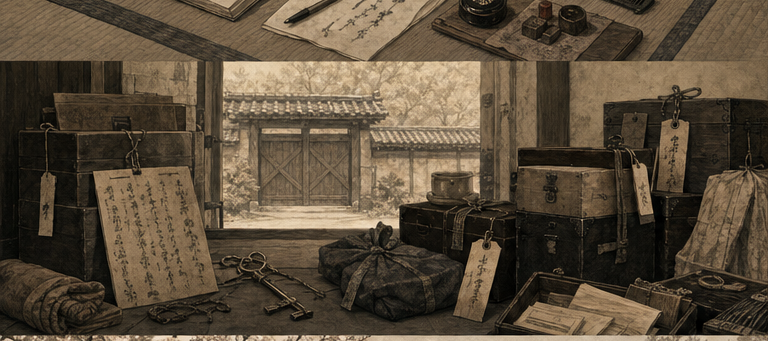
Inanoemon’s uprising, campaigns, westward march, surrender, and execution in Tsuruga occurred through different places and dates from collective punishment imposed on family remaining in Mito. Confiscation orders, property inventories, seals placed on a residence, keys, clothing bundles, kinship rosters, summonses, custody orders, and stipend termination show how one person’s political act could remove housing, food, movement, and legal security from relatives and dependents. The illustration offers types of evidence, not Yae’s authenticated belongings. Mother, daughters, sons, servants, and extended kin should not be assigned one identical sentence or date; each requires a named register. Reading paths move beyond heroic uprising toward family property, women’s and children’s legal status, confiscation, house arrest, and custodial placement.
Families connected to the Tengu Party were detained after the affair, and Akanuma prison remains part of Mito’s memory. Reference research places its compound in present-day Higashidai 2-chome, but Yae’s specific prison and confinement dates have not been verified. Straw mats, bedding, water jars, bowls, lamps, medicine packets, clothing, inspected parcels, ration books, sick lists, and prisoner registers provide evidence for the daily conditions of women and children in custody. The page does not make bars or suffering into visual spectacle. Numbers, cell allocations, food quantity, hygiene, nursing, visits, parcels, and deaths require records. A site identification for Akanuma is not proof that Yae was held there. Reading paths include early-modern prisons, female prisoners, children under collective punishment, food, medicine, and sanitation.
A widely circulated account identifies Tamaru Inanoemon’s second daughter as Yae, says that she was seventeen, and has her compose “Together we set out on the journey to death while flowers are in full bloom” before beheading by the Shosei faction. The Ibaraki Prefectural Archives and Museum account confirms instead that her father, a Mito town magistrate, became the nominal leader of the March 1864 Tsukuba uprising. Separate records establish his later execution at Tsuruga, the detention and punishment of families connected to the Tengu Party in Mito, and the location of Akanuma prison in present-day Higashidai 2-chome. The materials located so far do not include an execution order or register naming Yae, her execution date, companions, route from prison, execution site, transfer of remains, or grave. Yoshinuma, Yoshida-Sakaibashi, Mukaihara, and other sites used after the affair therefore cannot be assigned to her without further evidence, and “full bloom” cannot be treated as an eyewitness description of the scenery.

The verse usually translated as “Together we set out on the journey to death while flowers are in full bloom” circulates as the death poem of Tamaru Inanoemon’s seventeen-year-old second daughter Yae. The autograph, contemporary copy, earliest printed source, textual variants, reading, and companions remain to be located. Variant manuscripts, quotation cards, thread-bound local histories, newspapers, commemorative journals, catalogs, and publication chronologies can expose circular citation in which later works repeatedly copy one unsupported statement. The origin of the variant name Yatsu is likewise uncertain and requires source-based investigation. The poem does not prove every circumstance of death; it reveals how later periods selected language to remember punished families. Reading paths include Mito women, death poetry, short verse, oral tradition, local historiography, and source criticism.
VISIT
Search events related to Yae Tamaru →Browse all Bakumatsu events →